
Issue #006
The Hello → Demo Matrix.
Pull a list of the last twenty people your team reached out to.
Ask one question of each name. Why this person?
Watch how many answers come back as a shrug.
Most teams skip the part that decides everything. They go straight to outreach. They guess at who. They assume the why. They spray and pray and call it pipeline.
The intelligence phase gets cut because it feels slow.
So the team moves fast in the wrong direction.
AI doesn’t fix this. AI lets you guess at scale. More messages to the wrong people, written faster, landing nowhere. AI doesn’t create pipeline. Systems do.
The system that creates it is the Hello → Demo Matrix. Not a CRM. It’s the knowledge base of everything you must know about your buyer before you send a single message. It sits in the Foundation layer of the architecture, and every layer above it runs on what it holds.
Sixteen components, in four groups. Each group answers one question.
Market Reality. Who’s hurting, and where.
Popular Pain - the pain that’s common, urgent, and recognizable.
Industry Verticals - where that pain shows up most clearly.
Market Segmentation - which slices of the market are worth separating.
Prospect & Customer Interviews - what buyers actually say in their own words.
Buyer Fit. Who’s worth pursuing.
Persona Roles - who’s involved in the buying decision.
Buying Windows - when they’re most likely to move.
Do Not Call List - who looks tempting but should be avoided.
Ideal Qualified Prospect - what a truly qualified prospect looks like.
Message & Proof. Why they should believe you.
Tangible Results - the measurable outcomes you create.
Case Studies - where you’ve proven it before.
Social Proof - who else trusted you, and what happened.
Unique Differentiators - why you, instead of another option.
Sales Friction. What could stop the deal.
Red Flags & Deal Breakers - the early signals a deal won’t close.
Believable Solutions - what you can promise without sounding fluffy.
Competitors - who else you’re being compared against.
Objections Handling Guide - what buyers push back on, and how you answer.
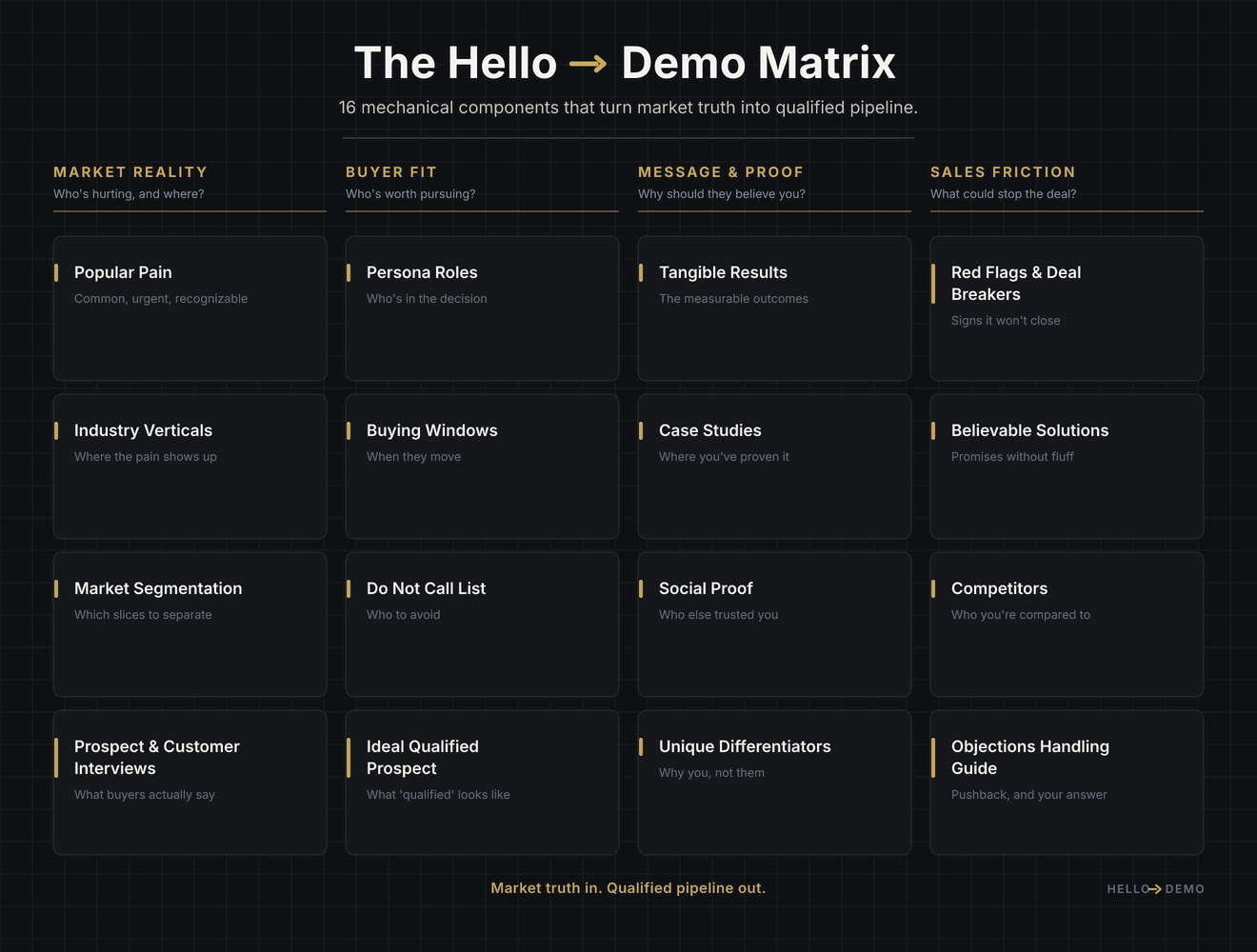
Build it once and the whole architecture has what it needs. Market Reality grounds the physics of your market. Buyer Fit sets your qualification and targeting. Message and Proof arms your trust layer. Sales Friction arms the conversation.
You build it from real conversations, not proxies, and you start with the customers you already won. Interview your top ten clients and your ten fastest wins. Ask why they bought, what almost stopped them, and what made it finally click. The pattern across those accounts is your real buyer. It does two things at once. It sharpens the message until it sounds like it was written for them, and it tells you exactly which companies to aim at next, the ones that match the pattern.
Then pressure-test it against the market. Twenty prospect interviews over six to eight weeks. The first five find the white space. The next five confirm the pattern. The last ten sharpen the message until it’s unmistakable. Your customers show you what already works. The market shows you how far it travels.
And it compounds. The personas you define today shape the lists you build tomorrow. The objections you catalog now become the responses that close next quarter. Insight compounds. Notes don’t.
The Matrix isn’t a one-time exercise you finish and file. It’s the operating system that gets sharper every conversation. Over time it becomes the thing your competitors can’t copy, because they never did the work.
One move this week.
Make two lists. Your ten best clients, and your ten fastest wins. The accounts you’d clone if you could.
This week, get one real conversation with three of them. Ask why they bought, what almost stopped them, and what made it finally click. Don’t rebuild it from memory. Hear it in their words.
Read the answers side by side and the pattern shows up fast. That pattern is your real buyer, not the buyer in your deck. Then point everything at the companies that match it. And remember: guessing at who you target shows up in what you pay to acquire them. Run the CAC Calculator
If you can name the exact buyer your whole system points at, who are the twenty names that match, and who are the twenty you should stop chasing?
When you want to see whether your targeting is grounded or guessed, the diagnostic takes five minutes:
Take the 5-Minute Revenue Diagnostic
“Be thou diligent to know the state of thy flocks, and look well to thy herds.”— Proverbs 27:23
Cheers,

Alex Balingit
Founder, Hello → Demo