
Issue #005
Revenue Infrastructure.
A team can run the plays, hit the activity, buy the tools, and still miss the number.
Then they do more of all of it and miss again.
When a number comes in soft, almost everyone reaches for the same lever: effort. Work the pipeline harder. Add headcount. Add another tool to the stack.
It feels like action. It rarely moves the number.
Because you can’t outwork a broken foundation.
Revenue is not a sales problem. It’s an infrastructure problem. Performance is the output. Infrastructure is the cause.
Underneath every number sits a stack of layers, built from the bottom up.
1 - Product-market fit. Customers pay for a real problem.
2 - Niche. A defined buyer with a defined problem.
3 - Messaging. A clear problem and a clear outcome.
4 - Go-to-market. Channels, cadence, conversion.
5 - The hello. Mutual qualification.
6 - The demo. Structured value validation.
7 - Won. Revenue retained, customers served.
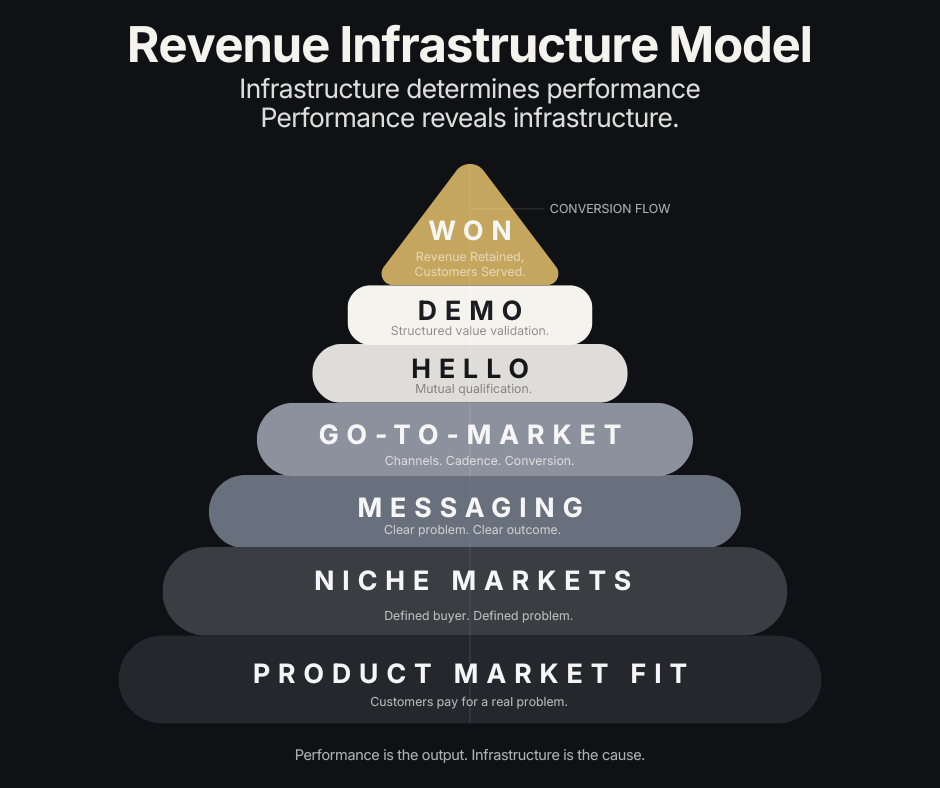
Conversion flows down through them from the top, but the stack is built from the bottom, and a crack in any layer caps everything above it. Inconsistent pipeline is usually the go-to-market layer. Leads that don’t convert is usually the messaging layer. Talking to the wrong people is the niche layer. The symptom shows up at the top. The cause always sits lower.
McKinsey studied 3,800 B2B decision-makers and found the winners don’t out-tactic anyone. They build the whole commercial system and run it in concert. Companies that did were twice as likely to grow market share by more than 10% than companies leaning on a single tactic. The bolt-on doesn’t win. The system does.
This isn’t new thinking. Companies with a formal sales process have long generated more revenue growth than companies running on improvisation. Not because their reps work harder. Because the foundation under the reps holds.
Performance is the output. Infrastructure is the cause.
One move this week.
Take the symptom that’s loudest right now. The one keeping you up. Then resist the urge to solve it where it shows up.
Pipeline’s thin? Don’t add reps yet. Walk down the stack. Is the go-to-market motion defined, or improvised? Is the message clear, or just clever? Is the niche named, or assumed?
Find the lowest layer that’s weak. That’s the cause. Everything you were about to spend on the symptom would have leaked straight through it. Before you spend another dollar, see what the broken foundation is already costing you in reps who can’t sell: Run the Administrative Drag Calculator
If your number is soft this quarter, which layer is actually weak, and are you fixing the cause or the symptom?
When you want to see which layer is capping your number, the diagnostic takes five minutes:
Take the 5-Minute Revenue Diagnostic
Sources: McKinsey B2B Pulse (survey of 3,800 decision makers) · Harvard Business Review.
“Prepare thy work without, and make it fit for thyself in the field; and afterwards build thine house.”— Proverbs 24:27
Cheers,

Alex Balingit
Founder, Hello → Demo